
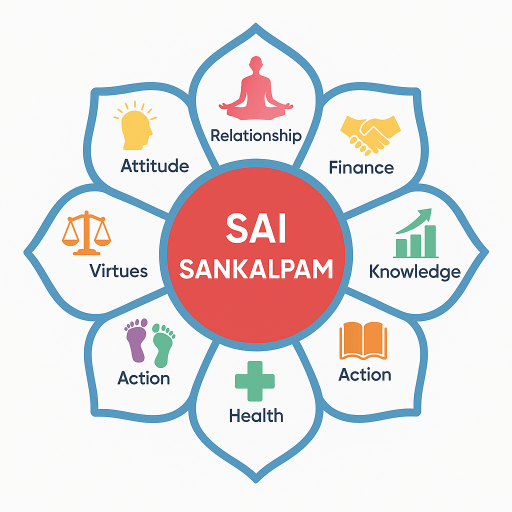
Sai-centric Parenting: Building a Child’s Four Pillars with the T.E.A.R. Formula
In today’s fast-paced world, parenting often feels like navigating through a constantly changing landscape. As a doctor and a parent deeply inspired by Sai Baba’s teachings, I’ve found that the principles of Sai-centric parenting can provide invaluable guidance. At the heart of this approach is nurturing a child’s growth across four essential pillars: Health, Relationships, Finance Values, and Knowledge. To support these pillars, I’ve developed the T.E.A.R. Formula—Togetherness, Empathy, Awareness, and Responsibility.
Health: Togetherness as Foundation
When we consider health from a Sai-centric viewpoint, it encompasses both physical and mental well-being. Togetherness is the key. I recall the evenings I spent with my children swimming together, sharing stories or meditating as a family. Not only did these activities improve our physical health, but they also created a sense of unity that bolstered mental well-being. This togetherness reduces stress and encourages cooperative behavior, creating a healthy environment where children can thrive.
Relationships: Empathy at Heart
In the realm of relationships, empathy is crucial. Sai Baba emphasized the importance of seeing divinity in everyone and treating others with compassion. I once faced a challenging situation with my son, who struggled to empathize with a classmate who was different from him. Together, we volunteered at a local soup kitchen. Through service, my son learned to appreciate diverse perspectives and understood the struggles of others, building authentic relationships rooted in empathy.
Finance Values: Awareness of Wants Versus Needs
While financial literacy is not extensively covered in traditional education, it is pivotal. Awareness helps distinguish between wants and needs. I fondly remember introducing my kids to the concept of saving by setting up small piggy banks. Each coin placed inside prompted discussions on needs versus wants, integrating lessons on savings and charity. Awareness in finance management lies not just in saving, but also understanding the value of each penny earned and spent.
Knowledge: Responsibility in Learning
The thirst for knowledge should be nurtured responsibly. As a doctor, I’ve been amazed at how inquisitive children are naturally. I was inspired to harness this when my daughter, dissatisfied with a school science project, took the initiative to build a simple model of the digestive system using clay. By encouraging her responsibility in seeking and acquiring knowledge, she not only excelled at school but developed a lifelong love for learning.
Discipline with Love
Discipline is integral to the Sai-centric approach. However, it should always be administered with love. I faced moments with my younger daughter, where traditional forms of discipline seemed counterproductive. Instead, I practiced ‘quiet time’—a nurturing pause where we’d sit quietly and reflect on actions. It worked wonders. This approach, rooted in love rather than fear, reinforced their understanding of consequences and choices.
Gratitude Journaling for Kids
Gratitude is a significant life skill and habit. Encouraging children to maintain a gratitude journal can profoundly impact their outlook on life. Every evening, my children and I write down three things we are thankful for. This simple act develops a positive mindset, fosters appreciation for life’s blessings, and builds resilience against adversity.
Service Activities as Real-Life Lessons
Service to others instills values that no education can, echoing Sai Baba’s teaching: “Hands that serve are holier than lips that pray.” Serving together as a family my children gained firsthand experience of love in action. Reflecting on service activities, such as organizing book drives or volunteering at animal shelters, my children realized the pleasures of helping others and developed moral values, compassion, and the spirit of community service.
Conclusion
In raising children under the principles of Sai-centric parenting, the T.E.A.R. Formula not only fortifies the Four Pillars of Health, Relationships, Finance Values, and Knowledge but also imbues them with character and integrity. In the end, it is their character that defines them, shaped by the values we nurture today. Sai Baba put it aptly, “The end of education is character.” By focusing on character and value education, we build a foundation for lifelong success and fulfillment.
As parents, we have a sacred responsibility. One rooted not just in responsibility but in love, empathy, and service. I hope my experiences and the T.E.A.R. Formula can guide you in strengthening your child’s four pillars, aligning with Sai Baba’s vision of universal love and peace.
For more insights on parenting and personal growth, visit Sai Parenting Resource or reach out at email.
🙏 Support SaiSankalpam
If this content has helped or inspired you, you may offer a voluntary contribution.
⚠️ Disclaimer:
This is a voluntary contribution. No goods or services are sold.
Payments are processed securely by your UPI app.
SaiSankalpam does not store or access your payment information.
Before you leave, offer Aarathi to Swamy and take His blessings
👁️ Viewed by 43,592 readers