

Reflecting on my journey, both as a pediatrician and a parent, I often find myself revisiting a simple, serene moment from years ago. I was sitting by the window, my young son curled up beside me as rain gently pattered against the glass. His inquisitive mind sprang question upon question about the world, and in those moments, I realized that parenting was not just about teaching but also about listening and learning. This lesson in patience and presence became a touchstone in my life, blending my medical knowledge with profound spiritual insights garnered from my journey as a seeker of Sai’s teachings.

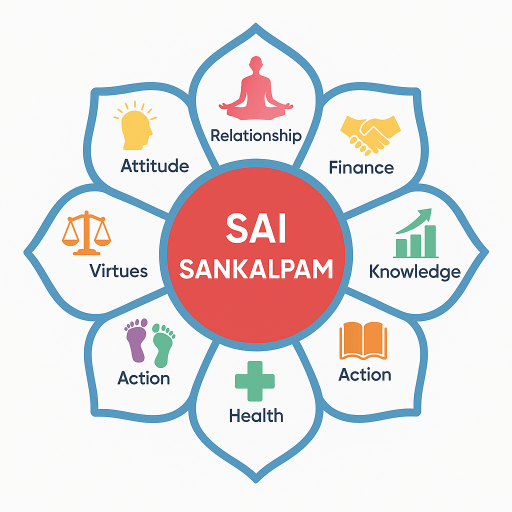
In the years of practicing medicine and weaving through the beautiful chaos of family life, I’ve come to understand the essence of what I like to call “Sai-centric Parenting.” It is the nurturing of a child’s Four Pillars of Life: Health, Relationships, Financial Values, and Knowledge, anchored deeply within the T.E.A.R. Formula – Thoughts, Emotions, Actions, and Results.
Let’s begin with Health, the cornerstone of a nourishing life. The belief that “health is wealth” resonates through time and is affirmed in my practice every day. With conscious communication, we can impart the importance of nutrition and exercise. For instance, a simple daily routine of preparing meals together can teach children valuable lessons in nutrition while fostering strong family bonds. It’s crucial to guide them in understanding their body’s signals, thus nurturing a healthy emotional relationship with food and exercise.
In one heartfelt encounter, a young patient of mine who struggled with obesity began a transformation not through strict diets but through the loving encouragement of a father who started jogging with him every morning. This wholesome activity not only improved the child’s health but also cemented an unspoken bond between them.
Relationships form the heart of our life’s tapestry. Sai’s teaching, “Love all, serve all,” becomes the guiding principle here. As parents, we can model empathy and compassion through our interactions. Encouraging children to partake in seva, or service activities, cultivates a deep sense of empathy and interconnectedness. In my own home, we recounted each day’s simple acts of kindness during dinner, which blossomed into a gratitude journaling practice. Recognizing and recording these moments of joy and kindness nourishes a child’s emotional intelligence and their capacity to build and sustain meaningful relationships.
Financial Values may seem distant concerns for the young, but the seeds sown early yield substantial trees of wisdom. Teaching children through actions, such as saving a portion of their allowance or involving them in charitable giving, molds their relationship with money into one of responsibility and awareness. My spiritual path with Sai has taught me that true wealth lies in how generously we give and share. Parents can shape their children’s thoughts and emotions about wealth through everyday actions and discussions about need versus want, generosity versus greed.
Knowledge, the final pillar, is perhaps the most transformative when coupled with curiosity and humility. It’s not merely academic; it is spiritual wisdom and practical understanding. When children witness us engaging with the world as learners – be it through reading diverse materials or reflecting on the teachings of Swami – we beckon them toward a lifelong quest for truth and wisdom. Encourage children to ask questions and provide them with answers laced with moral values and spiritual insights.
I recall a vibrant discussion with my daughter as we knitted stories about each constellation in the sky. This sparked her interest in astronomy, but more importantly, it opened a channel for discussing the interconnectedness of the universe, a teaching central to Sai Baba’s philosophy.
Every day offers an opportunity to build upon these pillars with love and gentleness, akin to nurturing a delicate plant that will eventually stand tall and strong. Discipline, too, aligns with love and wisdom. Instead of punitive measures, guide children through understanding the consequences of their actions, reinforcing the T.E.A.R. model: these challenges become teachable moments that build character.
In all endeavors, remember the profound words of Sai Baba: “The end of education is character.” True education is not about amassing knowledge, but about developing a character imbued with virtues.
Please share your thoughts, experiences, or questions in the comment box below. I read every comment with love and deep respect.
🙏 Support SaiSankalpam
If this content has helped or inspired you, you may offer a voluntary contribution.
⚠️ Disclaimer:
This is a voluntary contribution. No goods or services are sold.
Payments are processed securely by your UPI app.
SaiSankalpam does not store or access your payment information.